Nearly every team has a staging environment, and nearly every team has a story about something that passed staging and broke production: a migration that was instant against two thousand rows and locked a forty-million-row table, a feature that worked in staging's single-region configuration, an integration pointed at a sandbox that behaves differently from the real API. Over time staging becomes a shared, drifting, half-broken environment that five teams queue for, and people begin testing in production by default because it is the only environment that tells the truth. The fix is not a bigger staging environment. It is being specific about what each pre-production environment is supposed to prove.
Why shared staging decays
- Drift. Manual changes, hotfixes applied to production but never to staging, and configuration differences accumulate until the two environments no longer resemble each other.
- Contention. One environment, many branches, and a single broken deploy blocks every team behind it.
- Data. Either a tiny synthetic dataset that looks nothing like reality, or — worse — a copy of production containing real customer data.
- Cost pressure. Staging gets scaled down until performance and concurrency bugs no longer reproduce there.
- Ownership. It is nobody's job, so nobody fixes it, and every engineer learns to route around it.
Parity: what has to match and what does not
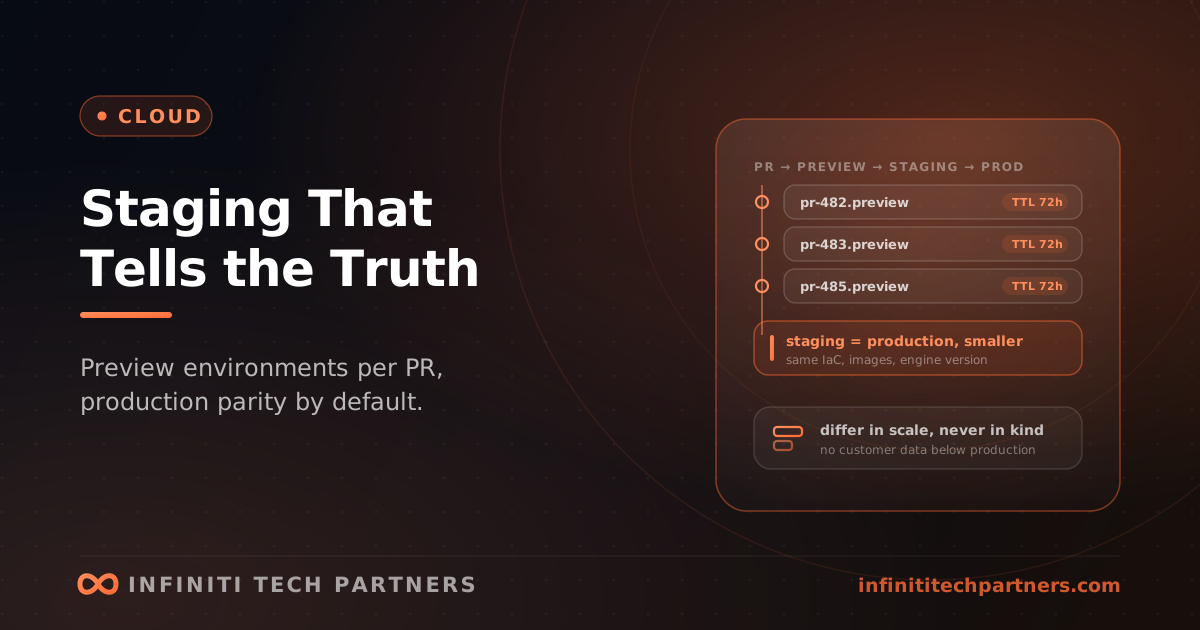
The rule that resolves most arguments is that environments may differ in scale but never in kind. What has to match is everything structural: the same infrastructure-as-code modules with different variables, the same container images promoted between environments rather than rebuilt, the same database engine and major version, the same configuration shape with secrets delivered through the same secrets mechanism, the same network topology where it matters — private endpoints, TLS termination, egress rules — and the same feature flag system. What can legitimately differ is size: instance types, replica counts, retention periods, the number of regions. A staging environment that runs on a different database version or bypasses the load balancer is not a smaller production; it is a different system, and passing tests in it proves correspondingly little.
Preview environments per pull request
An ephemeral, full-stack environment per pull request — created when the PR opens, destroyed when it merges or closes, reachable at its own URL — removes the staging queue entirely. Product and design review real behaviour before merge, QA runs in parallel, and a broken branch breaks nobody else. The usual implementation is a namespace per branch on Kubernetes or an equivalent on a managed platform, with databases provided through copy-on-write branching where the database supports it or restored from a seeded snapshot where it does not. Expensive shared services, such as a search cluster, can be shared with per-environment prefixes, and third-party integrations are pointed at sandboxes or stubs. Cost is controlled by lifecycle rather than size: destroy on close, expire after a period of inactivity, and scale idle environments to zero. A preview environment is cheap per day when it is destroyed reliably; the cost problem is always the ones that were forgotten. Done well, this is one of the most visible wins a platform engineering investment delivers.
Test data that is realistic without being production
- Never copy production customer data into lower environments. It widens the scope of any breach to every environment and every engineer, and it is a finding waiting to happen under SOC 2, GDPR, and HIPAA.
- Maintain seed scripts that generate a representative shape: multiple tenants, one tenant at roughly the volume of your largest customer, and the edge cases — unusual characters, empty states, deleted users, maximum-length fields.
- Where synthetic data is not enough, produce a masked subset of production through a reviewed pipeline with irreversible transformations, never an ad-hoc dump.
- Keep a production-scale dataset specifically for rehearsing database migrations, and run every migration against it before it ships.
What pre-production cannot prove
No pre-production environment reproduces real traffic patterns, real third-party behaviour, or real scale, and pretending otherwise is how teams end up trusting staging for things it cannot tell them. The honest model has three layers. Preview environments prove the feature works. A parity staging environment proves the deploy, the configuration, and the migration work. Progressive delivery in production — canaries, flags, and dark launches — proves it works under real load with real users. Capacity questions belong in a dedicated, properly scaled environment for load testing, run deliberately rather than inferred from staging.
How Infiniti Tech Partners approaches this
We have designed ephemeral environments as a product, not only configured them for clients: MicroDataCluster, one of our own platforms, provides on-demand sandbox environments that are disposable, isolated, and torn down automatically, and the lessons from building it — lifecycle over size, isolation by default, cleanup that cannot be forgotten — are the same ones that make preview environments work inside a client's delivery pipeline. A typical engagement brings environments to parity through shared infrastructure code, builds the per-PR preview pipeline, replaces production data copies with seeded and masked datasets, and adds the expiry and cost controls, usually over a few weeks. We keep a deliberately small number of concurrent engagements and plan the calendar about a quarter out. If your team has stopped trusting staging, that is a problem with a well-understood fix.
Frequently asked questions
What are preview environments?
Preview environments are ephemeral, full-stack environments created automatically for each pull request, reachable at their own URL and destroyed when the pull request merges or closes. They remove the queue for a shared staging environment, let product, design, and QA review real behaviour before merge, and mean a broken branch breaks nobody else. They are typically built with a namespace per branch and databases provided by copy-on-write branching or a seeded snapshot, with costs controlled by automatic expiry and scale-to-zero.
How closely should staging match production?
Environments may differ in scale but never in kind. Staging should use the same infrastructure-as-code modules, the same container images promoted rather than rebuilt, the same database engine and major version, the same secrets mechanism and configuration shape, the same relevant network topology, and the same feature flag system. Instance sizes, replica counts, retention, and the number of regions can legitimately be smaller. A staging environment on a different database version is a different system, and passing tests in it proves little.
Should you copy production data into staging?
No. Copying production customer data into lower environments widens the scope of any breach to every environment and engineer, and creates findings under SOC 2, GDPR, and HIPAA. Use seed scripts that generate a realistic shape, including multiple tenants, one at roughly your largest customer's volume, and edge cases. Where more realism is needed, produce a masked subset through a reviewed pipeline with irreversible transformations, and keep a production-scale synthetic dataset for rehearsing database migrations.
Related reading
Cloud Lock-In: What an Exit Plan Actually Costs
Avoiding every managed service is expensive insurance against an event that rarely happens. Where lock-in hurts, and what portability is worth buying.
CloudLoad Testing and Capacity Planning: Find the Breaking Point First
Autoscaling doesn't tell you where your system breaks. How to run load tests that produce a number you can plan with, and what usually fails first.
CloudMulti-Region Architecture: When You Actually Need It, and What It Costs
Multi-region gets proposed for latency, availability, or data residency — three different problems needing three different architectures. How to tell which one you have before you rebuild.