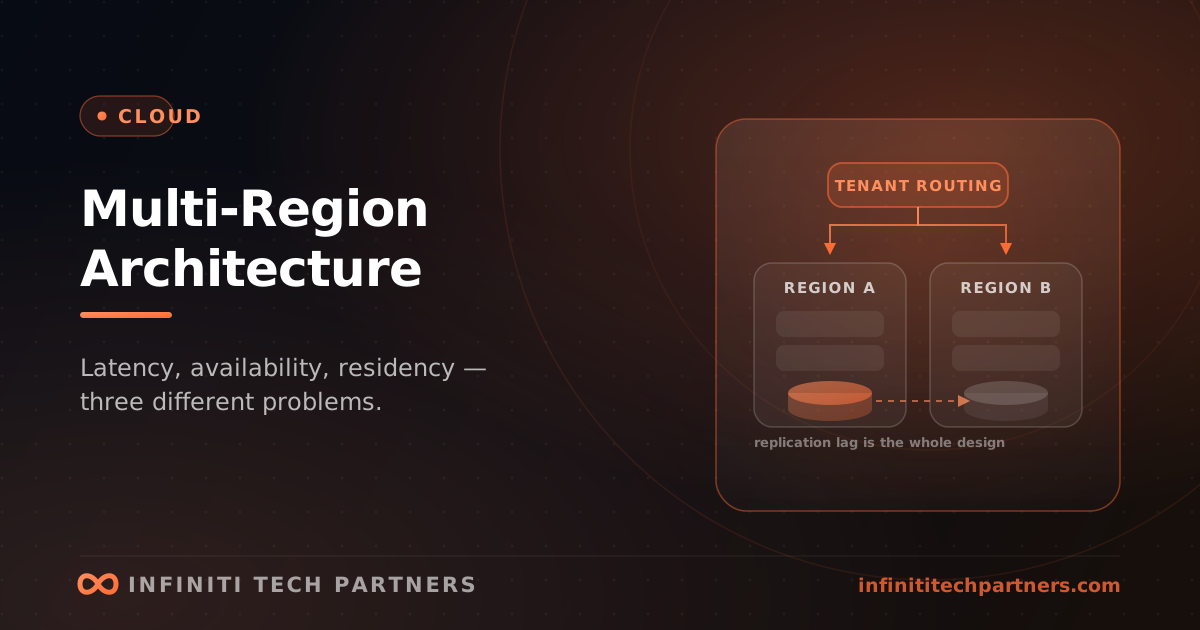
Multi-region architecture gets proposed for three quite different reasons, and the most common mistake is treating them as one project. A customer complains that the app feels slow from Sydney. A prospect's security review asks what happens if your primary region fails. A European buyer says their data cannot leave the EU. Those are a latency problem, an availability problem, and a compliance problem — and they call for different architectures with wildly different costs. Building full active-active infrastructure to fix a latency complaint that a CDN and a read replica would have solved is one of the more expensive ways a growth-stage engineering team can spend a year.
Three reasons, three architectures
If the driver is latency, the answer is usually not multi-region at all in the database sense. Static assets and cached responses at the edge, plus regional read replicas for read-heavy paths, address the large majority of perceived slowness — most of which is round trips and payload size rather than distance to the write node. If the driver is availability, what you need is a defined recovery posture: a warm standby in a second region with replicated data, tested failover, and honest RTO and RPO numbers, which is a disaster recovery problem rather than a distributed-systems one. If the driver is data residency, you need genuine regional isolation — separate stacks holding separate customers' data, with routing that puts each customer in the right one — and notably you do not need those regions to share a database, which makes it the more tractable of the three despite sounding like the hardest. Naming which of the three you're solving is most of the architectural decision.
The database is the whole problem
Everything else in a multi-region design is comparatively easy. Stateless application tiers replicate trivially; state does not. The moment you want writes accepted in two regions, you are choosing among unattractive options: a single writer with cross-region write latency for distant users, asynchronous replication with a real window of data loss on failover, a distributed SQL database that gives you multi-region consistency at the cost of higher per-transaction latency and operational unfamiliarity, or application-level conflict resolution, which means designing your data model so concurrent writes in different regions can be merged deterministically. That last option is where teams underestimate the work by an order of magnitude, because conflict resolution isn't a database feature you enable — it's a property of every entity in your domain, decided one at a time. Replication lag compounds it: a user who writes in one region and reads from another sees their own change disappear, so you need read-your-writes handling, sticky routing, or explicit staleness tolerance per endpoint. And you need a considered answer to split-brain, because a network partition between regions with a naive failover policy produces two authoritative databases and a manual merge nobody wants to perform.
The costs that don't appear in the design doc
- Cross-region data transfer, which is billed per gigabyte and becomes a top-five line item on the cloud bill faster than teams expect.
- Duplicated infrastructure that is mostly idle — you're paying for capacity in a second region that serves little or no traffic in the normal case.
- Deployment complexity: every release is now a multi-region rollout with ordering constraints, and schema migrations must be compatible across regions running different versions for a window.
- Testing failover for real, which means scheduled drills that route production traffic, not a runbook nobody has executed.
- Observability that is region-aware, so you can tell a regional degradation from a global one during the ten minutes that matter.
- On-call cognitive load — engineers now have to reason about which region a given customer's request and data are in, at three in the morning.
What most companies actually need first
For the large majority of growth-stage SaaS, the right posture is a single region done properly: deployed across multiple availability zones so a datacentre failure is survivable, with automated database failover within the region, a CDN in front of everything cacheable, read replicas where read volume justifies them, and a tested restore path into a second region for genuine disaster recovery. That configuration delivers the availability numbers most SLAs promise, costs a fraction of active-active, and — importantly — keeps your architecture comprehensible to a team that also has a product to build. Multi-region becomes genuinely necessary when you have a contractual availability commitment that a single region cannot satisfy, when a meaningful share of revenue sits in a geography where the latency is costing you deals, or when residency requirements leave you no choice. Those are business triggers, not engineering preferences, and if you can't point to one, the honest answer is that you're not there yet.
If residency forces your hand
Residency-driven multi-region is a different and more pleasant shape of problem, because the requirement is isolation rather than global consistency. The pattern that works is a full regional stack per jurisdiction — application, database, storage, queues — with each customer's data resident in exactly one, and a thin global layer handling only what genuinely must be shared: a routing directory that maps a customer to their region, and possibly billing and administrative metadata that carries no regulated data. Customer-level routing then happens as early as possible, at the identity or DNS layer, so a request never touches the wrong region. This is closely related to cell-based architecture, and it brings a nice side effect: regional stacks are also blast-radius boundaries, so a bad deploy or a runaway tenant is contained to one cell. The work that catches people out is not the infrastructure but the inventory — knowing precisely which data stores, logs, backups, analytics pipelines, and third-party processors touch customer data, because residency claims cover all of them and the logging pipeline is the one that's usually forgotten. That inventory is the same one your GDPR obligations require, so the effort does double duty.
How Infiniti Tech Partners approaches multi-region
Our first job on these engagements is usually to establish which of the three problems you actually have, because the answer frequently changes the scope by a factor of five — and quite often the latency complaint that started the conversation is solved with caching and read replicas in a fortnight. Where multi-region is genuinely warranted, we design to the driver: warm standby with tested, timed failover when availability is the requirement; regionally isolated cells with early routing and a full data inventory when residency is; and full active-active only when the business case for it survives an honest look at the cross-region data transfer bill and the on-call burden. We build the failover drills into the engagement rather than leaving them as a runbook, because an untested failover is a hypothesis. If you're weighing this — or a buyer has just asked a question that made you weigh it — a short architecture review will tell you which version of the problem you're looking at before you commit budget to the largest one.
Frequently asked questions
When does a SaaS actually need multi-region architecture?
Multi-region gets proposed for three different reasons — latency, availability, and data residency — and each needs a different architecture. Latency complaints are usually solved by a CDN and regional read replicas, not by distributing writes. Availability is a disaster recovery problem: a warm standby in a second region with replicated data and tested failover. Residency needs genuine regional isolation, but notably not a shared database. Multi-region becomes truly necessary when a contractual availability commitment exceeds what one region can deliver, when meaningful revenue sits in a geography where latency is costing deals, or when residency requirements leave no choice — business triggers, not engineering preferences.
What makes multi-region hard — is it the application or the database?
The database is effectively the whole problem; stateless application tiers replicate trivially. Accepting writes in two regions forces a choice among unattractive options: a single writer with cross-region write latency, asynchronous replication with a real data-loss window on failover, a distributed SQL database that trades per-transaction latency for multi-region consistency, or application-level conflict resolution — which teams underestimate badly, because it isn't a database feature you enable but a property of every entity in your domain, decided one at a time. Replication lag adds read-your-writes problems, and a network partition with naive failover produces split-brain and a manual merge nobody wants to perform.
What's the right architecture when data residency requires regional isolation?
Run a full regional stack per jurisdiction — application, database, storage, queues — with each customer's data resident in exactly one, plus a thin global layer handling only what must be shared, typically a routing directory mapping customer to region and administrative metadata carrying no regulated data. Route at the identity or DNS layer as early as possible so a request never touches the wrong region. This is close to cell-based architecture and brings a useful side effect: regional stacks become blast-radius boundaries. The hard part isn't infrastructure but inventory — knowing exactly which data stores, logs, backups, analytics pipelines, and third-party processors touch customer data, since residency claims cover all of them and the logging pipeline is the one usually forgotten.
Related reading
Cloud Lock-In: What an Exit Plan Actually Costs
Avoiding every managed service is expensive insurance against an event that rarely happens. Where lock-in hurts, and what portability is worth buying.
CloudLoad Testing and Capacity Planning: Find the Breaking Point First
Autoscaling doesn't tell you where your system breaks. How to run load tests that produce a number you can plan with, and what usually fails first.
CloudCloud Migration: Lift-and-Shift or Re-Architect?
How to move to the cloud without overspending or stalling — the real tradeoffs between lift-and-shift and re-architecting, why 'the cloud is cheaper' is a trap, and a pragmatic phased path most growth-stage teams should take.