Seat-based pricing has a convenient property: the thing you bill for is a row in a table, and it changes rarely. Usage-based pricing has none of that. The moment your invoice depends on counting events — API calls, documents processed, gigabytes stored, tokens consumed — billing becomes a distributed data pipeline whose output is a number a customer's finance team will scrutinise. The engineering problem is not calculating a price. It's producing a count that is correct, reproducible, explainable months later, and visible to the customer before the invoice arrives. Teams that treat metering as a billing integration ship something that mostly works and then spend the next year handling disputes. Teams that treat it as a data-integrity problem ship something that holds.
Metering is an event pipeline, not a counter
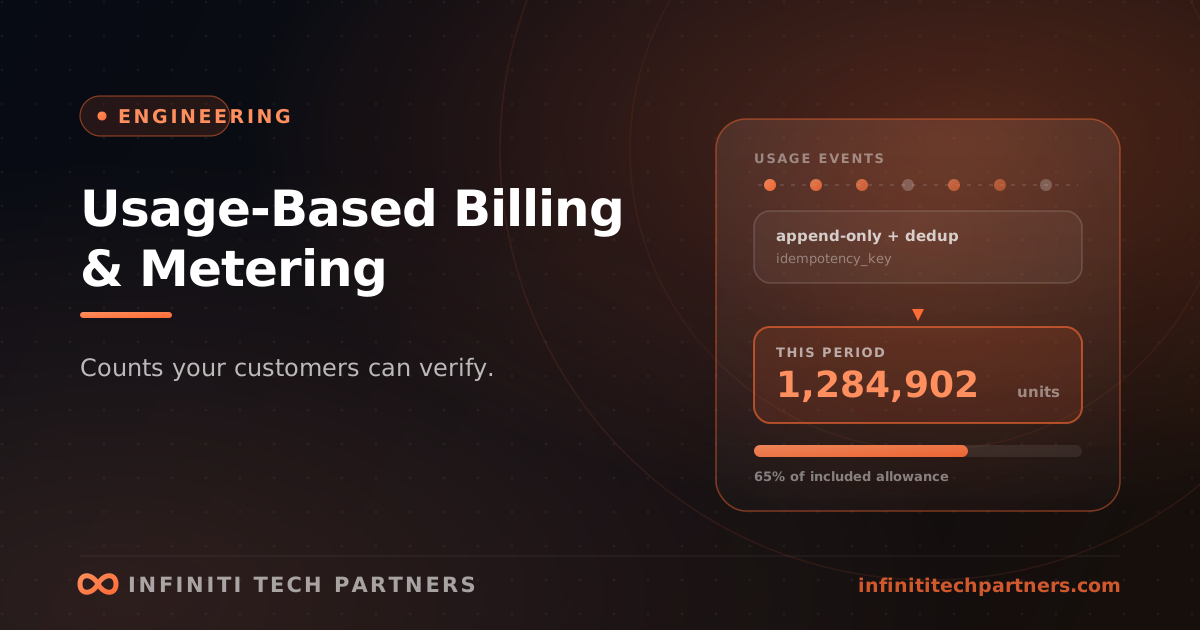
The tempting first implementation — increment a column on every request — fails in ways that are hard to unwind. It gives you no audit trail, so when a customer challenges a number you have nothing to show them. It loses data under retries and partial failures. And it makes any correction a manual database edit. The durable shape is to emit an immutable usage event at the point of consumption, carrying a stable idempotency key, the customer and subscription it belongs to, a timestamp generated server-side, the quantity, and enough dimensions to explain the charge later. Those events land in append-only storage, get deduplicated on the idempotency key, and are aggregated into billing periods by a job you can re-run. That last property is the one worth paying for: when you find a bug in your rating logic, the difference between a bad afternoon and a bad quarter is whether you can recompute from raw events instead of reconstructing history from invoices.
The details that generate disputes
- Late-arriving events: a batch job reports usage from three days ago after the period closed. Decide in advance whether it lands in the closed period as a correction or the open one, and make it consistent.
- Timezone and period boundaries — the customer's midnight is not your server's. Anchor billing periods to a defined timezone per account and document it.
- Rounding and units: round per event or per period, and at what precision? For high-volume, low-unit-price products these choices differ by real money.
- Mid-period plan changes, upgrades, and prorations, especially when they change the rate a unit is charged at.
- Failed and retried operations: is a request that returned a 500 billable? Almost always no — and your metering has to know that, which means emitting on success rather than on receipt.
- Free tiers, included allowances, and committed spend drawdown, which is where most rating engines quietly get complicated.
Reconciliation is the ongoing job
There are at least three numbers in play — what your product recorded, what your billing system charged, and what the customer believes they used — and they will diverge. Build the reconciliation before you need it: a scheduled comparison of aggregated meter totals against what the billing provider has, with alerts on drift beyond a threshold, plus a way to trace any invoice line back to the events that produced it. When a customer asks why their bill doubled, the answer 'here are the eleven thousand calls, grouped by day and endpoint' ends the conversation in one exchange. Anything less turns into a week of engineering archaeology, usually while the account is deciding whether to renew. This is also where storage decisions bite: raw usage events are high-volume and you will be tempted to expire them quickly, but you need them for at least as long as a customer might reasonably dispute a charge — a rolling window measured in months, with aggregates retained far longer.
Build the parts that are yours, buy the rest
The market has matured, and there's a sensible division. Invoicing, tax, payment collection, dunning, and revenue recognition are commodity problems with real regulatory complexity — buy those, and don't let anyone talk you into building tax handling. Metering and rating are more of a judgment call: dedicated billing platforms handle event ingestion, aggregation, and complex pricing models well and will save you months, but they price as a percentage of billed revenue or per event, and they become a hard dependency in your critical path. The pattern that ages well is to own the usage event pipeline — emission, storage, deduplication, and your own aggregates, since those are what you need for in-product analytics and dispute handling regardless — and push clean, already-aggregated usage into whatever billing system prices and invoices it. That keeps your reconciliation source of truth in your own infrastructure and makes changing billing vendors a re-integration rather than a rebuild.
Visibility is the feature, not the invoice
The most common failure of usage pricing isn't inaccuracy — it's surprise. A customer who cannot see their consumption until the invoice arrives will experience every busy month as a billing incident, and the churn risk from one unexpected charge outweighs the revenue it captured. The countermeasures are product work, not billing work: a usage dashboard updated near-real-time with the same numbers the invoice will use, per-team or per-key attribution so the customer can find their own runaway script, configurable alerts at percentage-of-budget thresholds, and hard caps or throttles for customers who want them. This matters most for AI features, where a single integration change on the customer's side can move consumption by an order of magnitude overnight — the same dynamics that make LLM cost control an internal discipline make usage transparency an external obligation. Predictability is what makes consumption pricing survivable for a buyer, and buyers who can predict it expand on it.
How Infiniti Tech Partners builds billing systems
We build metering as a first-class data pipeline rather than a billing integration, because the parts that hurt later — idempotency, replayability, reconciliation, dispute traceability — are architectural decisions made at the start. A typical engagement covers the usage event schema and emission points, deduplicated append-only storage with re-runnable aggregation, the rating rules for your specific pricing model including allowances and commitments, integration with a billing provider for invoicing and tax, automated reconciliation with alerting on drift, and the in-product usage visibility that keeps invoices from becoming surprises. We also pressure-test the pricing model itself against edge cases — mid-period changes, failed requests, late events — before it ships, because the cheapest time to resolve an ambiguity is before a customer has an opinion about it. If you're moving from seats to usage, or launching an AI feature that has to be metered, this is a well-defined scope we can size quickly.
Frequently asked questions
How do you architect a usage metering system for consumption-based pricing?
Don't increment a counter column — it gives you no audit trail, loses data under retries, and makes every correction a manual database edit. Instead emit an immutable usage event at the point of consumption carrying a stable idempotency key, the customer and subscription, a server-generated timestamp, the quantity, and enough dimensions to explain the charge later. Those events land in append-only storage, get deduplicated on the idempotency key, and are aggregated into billing periods by a job you can re-run. Replayability is the property worth paying for: when you find a rating bug, you can recompute from raw events instead of reconstructing history from invoices.
What causes most billing disputes in usage-based pricing?
The recurring culprits are late-arriving events that show up after a period closes, timezone and period-boundary mismatches (the customer's midnight isn't your server's), rounding decisions made per-event versus per-period, mid-period plan changes and prorations, and whether failed or retried operations are billable — they almost always shouldn't be, which means emitting usage on success rather than on receipt. Free tiers, included allowances, and committed-spend drawdown are where rating engines quietly get complicated. Decide each of these explicitly before launch, because the cheapest time to resolve an ambiguity is before a customer has an opinion about it.
Should we build our own billing system or buy one?
Split it. Invoicing, tax, payment collection, dunning, and revenue recognition are commodity problems with real regulatory complexity — buy those, and don't build tax handling. For metering and rating, the pattern that ages well is to own the usage event pipeline (emission, storage, deduplication, your own aggregates), since you need those for in-product analytics and dispute handling regardless, then push clean pre-aggregated usage into a billing provider that prices and invoices it. That keeps your reconciliation source of truth in your own infrastructure and makes switching billing vendors a re-integration rather than a rebuild.
Related reading
Rate Limiting for SaaS APIs: Protecting the Platform Without Punishing Customers
Rate limits decide who gets degraded when load spikes. Choosing algorithms, keys, and quotas that protect the platform without breaking integrations.
EngineeringCode Review That Actually Catches Things
Most review comments are about naming while the authorization bug ships. What review is for, what to automate, and how to make it fast enough to trust.
EngineeringCustomer-Facing Analytics Without Wrecking Your Production Database
In-app dashboards are the feature most likely to take your site down. How to separate the read path, pre-aggregate, and decide whether to build or embed.