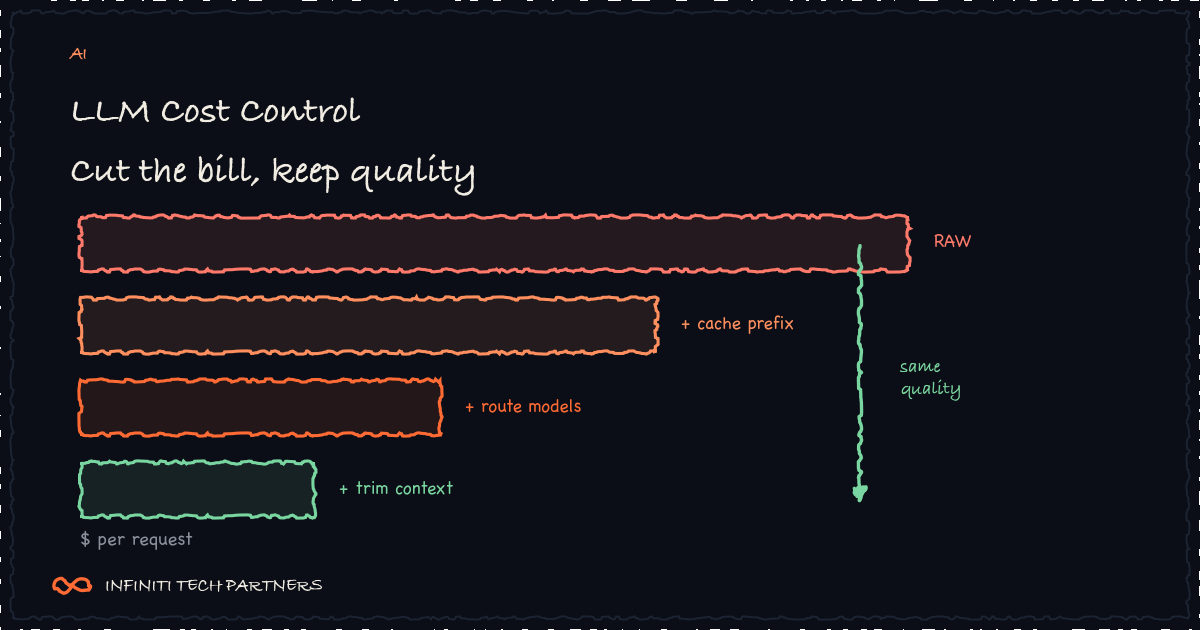
The AI feature ships, usage grows, and then the bill arrives — and it's growing faster than revenue. This is the moment a lot of GenAI products quietly stall: the unit economics don't work because the team optimized for 'does it work' and never for 'what does each call cost.' The encouraging news is that most LLM bills are full of waste, and the biggest savings come without touching quality. You don't need a cheaper model so much as a smarter system around the model.
Tokens are the meter — and you're overpaying on input
You pay per token, in and out, and the asymmetry surprises people: for most real applications the input dominates. Every call drags along a long system prompt, retrieved documents, and a growing conversation history, and you pay for all of it on every single turn. Teams obsess over the model's price-per-token and ignore that they're sending ten thousand tokens of context to answer a question that needed five hundred. The first place to look for savings is almost never the model — it's how much you're stuffing into each request.
Prompt caching: stop paying for the same prefix
If every request begins with the same large, static block — your system instructions, tool definitions, few-shot examples, a fixed knowledge base — prompt caching lets the provider charge a fraction of the price for that repeated prefix. The structural trick is ordering: put everything stable at the front of the prompt and everything variable (the user's actual message) at the end, so the cacheable prefix is as long as possible. For chat and agent workloads that replay a big system prompt thousands of times an hour, this one change can cut input costs dramatically with zero quality impact and almost no engineering.
Model routing: right-size each request
Not every request needs your most capable, most expensive model. A huge share of real traffic — classification, extraction, short factual answers, routing decisions — is handled perfectly by a smaller, cheaper, faster model. The pattern is a tiered cascade: send each request to the cheapest model that can do the job, and escalate to a bigger model only for the genuinely hard ones (or when a quick confidence check on the cheap model's answer says to). Done well, the user never notices, latency improves, and a large fraction of volume moves off your premium model. Routing is usually the single biggest lever after caching.
Context discipline and output limits
- Retrieve less, but better. Stuffing 20 documents into context 'to be safe' is expensive and often worsens answers; tighten retrieval to the few chunks that matter.
- Trim conversation history. Summarize or window long chats instead of replaying the entire transcript every turn.
- Cap output length. Open-ended generations drift long; set sensible max-output limits and ask for concise answers.
- Cache full responses for repeated identical questions — an FAQ-style hit shouldn't reach the model at all.
Measure per-feature, then set a budget
You can't control what you don't attribute. Tag every LLM call with the feature, the model, and the tenant, and put cost-per-request on a dashboard next to usage. Almost always a few features or a few heavy tenants drive the majority of spend — and once you can see that, the optimization work targets itself. Then set a token budget per feature as a guardrail, so a runaway loop or an abusive tenant trips an alert instead of a five-figure surprise at month-end. Cost observability is what turns one-off cleanups into spend that stays under control as you scale.
How Infiniti Tech Partners controls AI spend
We instrument your AI stack for per-feature cost visibility, then apply the levers in order of impact — prompt caching, model routing, retrieval and context discipline, output caps — so the bill drops without users noticing. The goal is GenAI features whose unit economics actually work at scale, not a demo that's quietly bleeding margin. If your AI costs are outrunning your revenue, start a conversation.
Frequently asked questions
How do I reduce my LLM API costs without losing quality?
Most LLM bills are full of waste, and the biggest savings come without touching quality, because you don't need a cheaper model so much as a smarter system around it. The levers, in order of impact, are prompt caching to stop paying for the same static prefix, model routing to right-size each request, retrieval and context discipline to send fewer tokens, and output caps. Tagging every call for per-feature cost visibility lets you see where the spend concentrates so the optimization targets itself.
How does prompt caching cut LLM costs?
If every request begins with the same large static block such as system instructions, tool definitions, few-shot examples, or a fixed knowledge base, prompt caching lets the provider charge a fraction of the price for that repeated prefix. The structural trick is ordering: put everything stable at the front of the prompt and everything variable, like the user's actual message, at the end, so the cacheable prefix is as long as possible. For chat and agent workloads that replay a big system prompt thousands of times an hour, this one change can cut input costs dramatically with zero quality impact and almost no engineering.
What is LLM model routing and how much does it save?
Model routing recognizes that not every request needs your most capable, most expensive model, since a huge share of real traffic like classification, extraction, short factual answers, and routing decisions is handled perfectly by a smaller, cheaper, faster model. The pattern is a tiered cascade: send each request to the cheapest model that can do the job and escalate to a bigger model only for the genuinely hard ones or when a confidence check says to. Done well the user never notices, latency improves, and routing is usually the single biggest lever after caching.
Related reading
Structured Outputs and Tool Calling: Making an LLM Return Something You Can Use
The gap between a demo and a product is usually parsing. How to get reliable structured output from a model, and where tool calling really breaks.
AIModel Routing and Provider Failover: Not Betting the Product on One Model
Hardcoding one model is an availability, cost, and quality risk. How to build routing and failover without an abstraction that costs more than it saves.
AIAI Coding Assistants in the SDLC: Where They Pay Off and Where They Cost You
A grounded look at AI-assisted development for engineering leaders — the work where it genuinely compounds, the second-order costs in review and security, and the guardrails worth setting.