Most SaaS disaster recovery plans share one fatal trait: they have never been tested. There's a backup job, a wiki page, and a comforting assumption that if the worst happens, it'll all work out. Then a region goes down or someone drops a production table, and the team discovers the backups are corrupt, the restore takes nine hours, or nobody knows who has the access to run it. A real DR plan starts with two honest numbers — RTO and RPO — and then proves, on a schedule, that you can actually hit them.
RTO and RPO: the two numbers that drive everything
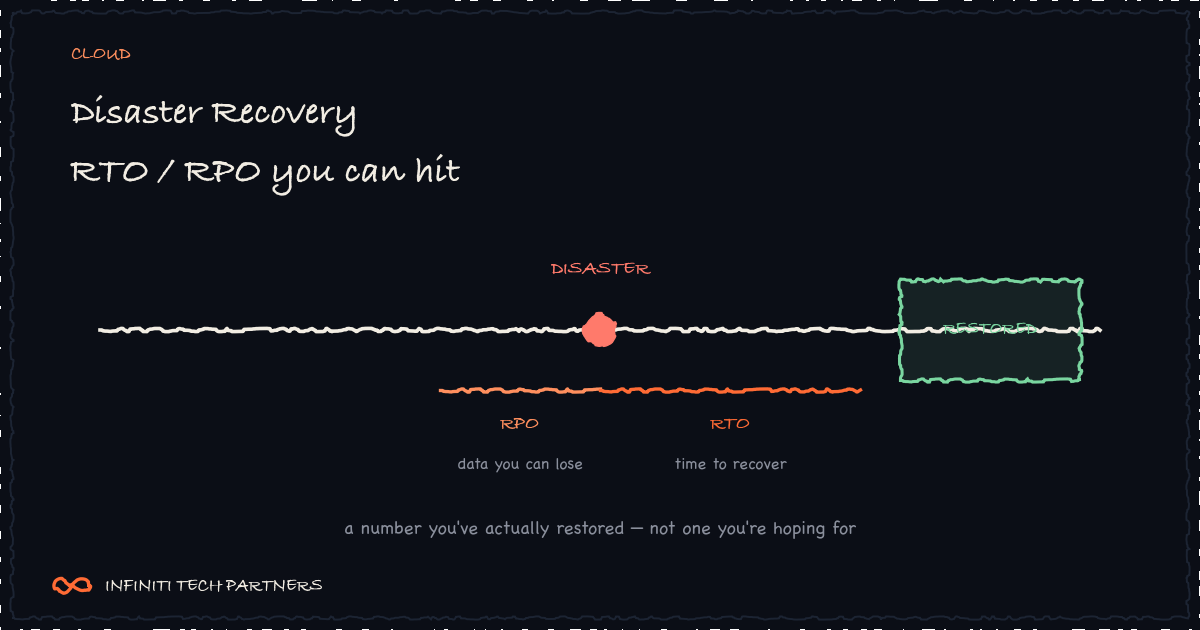
Recovery Time Objective (RTO) is how long you can be down before it's unacceptable. Recovery Point Objective (RPO) is how much data you can afford to lose, measured in time. If your RPO is five minutes, you need replication or backups at least that frequent; if your RTO is one hour, a restore process that takes six is a failure no matter how good the backup is. These targets aren't an engineering preference — they're a business decision, and different data deserves different numbers. Your core transactional database might warrant minutes; a regenerable analytics cache might tolerate a day. Set them deliberately, write them down, and design backward from them.
Backups you haven't restored are not backups
The most dangerous phrase in operations is 'we have backups.' A backup is a hypothesis until you've restored it. Backups silently corrupt, exclude a critical volume, encrypt with a key nobody can find, or take far longer to restore than anyone estimated. The only way to know your RPO and RTO are real is to perform actual restores on a schedule — into a clean environment, timed, verified for data integrity. A quarterly restore drill that produces a working system and a stopwatch number is worth more than a year of green backup-job dashboards. Test the restore, not the backup.
High availability is not disaster recovery
Teams often conflate the two and end up protected against the wrong failure. High availability — multi-AZ databases, redundant instances, load balancers — keeps you running through routine hardware and instance failures, and you should have it. But HA replicates your current state, including mistakes: a bad migration, a malicious actor, or an accidental mass-delete propagates to every replica instantly. Disaster recovery is what saves you from those — point-in-time backups you can roll back to, copies in a separate region or account that a compromise of your primary can't reach. You need both, and you need to be clear about which threat each one actually addresses.
The runbook has to work at 3am
- Write the recovery procedure as a step-by-step runbook a stressed on-call engineer can follow — not tribal knowledge in one person's head.
- Ensure access works during the disaster: if recovery needs credentials that live only in the system that's down, you have a deadlock. Keep break-glass access out-of-band.
- Define who decides to invoke DR, and how you communicate to customers and status page while it's underway.
- Store backups and the runbook in a blast radius separate from production — a different region or account — so the failure can't take out your recovery path too.
Practice the disaster before it practices on you
The teams that recover calmly are the ones who've rehearsed. Run a game day: deliberately fail over to your secondary, or restore production into a fresh environment, with the people who'd actually be on call, using only the runbook. You'll find the gaps — a missing permission, a step that's out of date, an RTO that's twice your target — while it's a drill and not an outage. Then fix them and do it again. DR is not a document you write once; it's a capability you maintain, and the only proof it works is that you've recently watched it work.
How Infiniti Tech Partners builds resilience
We set RTO and RPO targets against your real business risk, build the backup, replication, and cross-region recovery to meet them, and then prove it with scheduled restore drills and game days — plus a runbook your on-call can actually execute under pressure. Resilience you've tested, not resilience you're hoping for. If your DR plan has never survived a real rehearsal, start a conversation.
Frequently asked questions
What RTO and RPO should a SaaS aim for?
Recovery Time Objective (RTO) is how long you can be down before it's unacceptable, and Recovery Point Objective (RPO) is how much data you can afford to lose, measured in time. These targets are a business decision, not an engineering preference, and different data deserves different numbers: your core transactional database might warrant minutes, while a regenerable analytics cache might tolerate a day. If your RPO is five minutes you need replication or backups at least that frequent, and if your RTO is one hour a restore process that takes six is a failure no matter how good the backup is, so set them deliberately, write them down, and design backward from them.
Why isn't high availability the same as disaster recovery?
High availability, through multi-AZ databases, redundant instances, and load balancers, keeps you running through routine hardware and instance failures, but it replicates your current state including mistakes, so a bad migration, a malicious actor, or an accidental mass-delete propagates to every replica instantly. Disaster recovery is what saves you from those, using point-in-time backups you can roll back to and copies in a separate region or account that a compromise of your primary can't reach. You need both, and you need to be clear about which threat each one actually addresses.
How do I know my backups will actually work in a disaster?
A backup is a hypothesis until you've restored it, because backups silently corrupt, exclude a critical volume, encrypt with a key nobody can find, or take far longer to restore than anyone estimated. The only way to know your RPO and RTO are real is to perform actual restores on a schedule into a clean environment, timed and verified for data integrity. A quarterly restore drill that produces a working system and a stopwatch number is worth more than a year of green backup-job dashboards, so test the restore, not the backup.
Related reading
Cloud Lock-In: What an Exit Plan Actually Costs
Avoiding every managed service is expensive insurance against an event that rarely happens. Where lock-in hurts, and what portability is worth buying.
CloudLoad Testing and Capacity Planning: Find the Breaking Point First
Autoscaling doesn't tell you where your system breaks. How to run load tests that produce a number you can plan with, and what usually fails first.
CloudMulti-Region Architecture: When You Actually Need It, and What It Costs
Multi-region gets proposed for latency, availability, or data residency — three different problems needing three different architectures. How to tell which one you have before you rebuild.