Multi-tenancy is the single architectural decision that shapes your SaaS more than any other — it touches security, cost, performance, compliance, and how hard your biggest customer is to onboard. Get it right and you serve thousands of tenants on infrastructure that scales cleanly. Get it wrong and you discover, around the time an enterprise prospect asks for a signed data-isolation guarantee, that ripping it out means a rewrite. There are three models in practice, and the honest answer is that most successful SaaS companies end up running more than one at once.
Pooled: shared everything, isolate by key
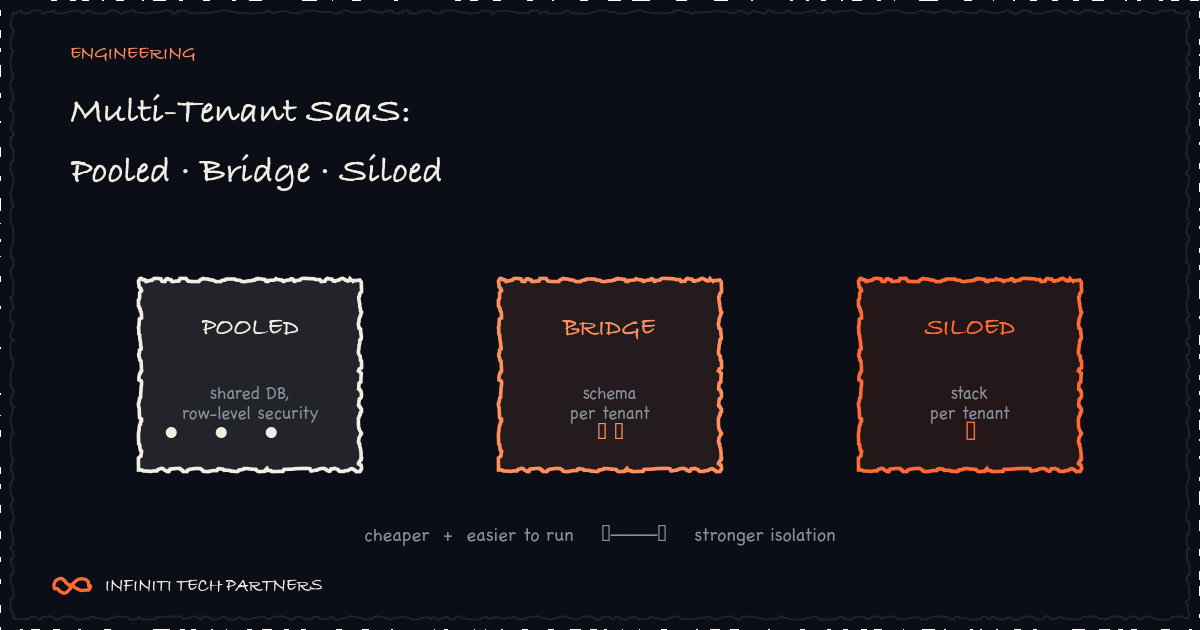
In the pooled model, all tenants share the same database and tables, and every row carries a tenant_id. Isolation is enforced in code — and, far more safely, by the database itself via row-level security. This is the cheapest model to run and the easiest to operate: one schema to migrate, one connection pool, one set of dashboards. It is the right default for the long tail of small and mid-sized customers. The risks are real but manageable: a single missing tenant filter is a cross-tenant data leak, so isolation must live at the database layer, not rely on every developer remembering a WHERE clause. The other risk is the noisy neighbor — one heavy tenant degrading everyone — which you handle with query limits, connection quotas, and good indexing.
Siloed: one stack per tenant
In the siloed model, each tenant gets its own database — sometimes its own entire stack. Isolation is physical and absolute, which is exactly what regulated buyers and large enterprises want to hear: their data never shares a table with anyone else's, and a per-tenant encryption key or even a per-tenant region becomes trivial. The price is operational. A schema migration now runs across N databases instead of one. Cost scales close to linearly per tenant rather than amortizing. And you need automation to provision, monitor, back up, and patch every silo, or your ops burden grows with every deal you close. Siloed is the right answer for your handful of largest, most security-sensitive accounts — not for self-serve signups.
Bridge: shared infrastructure, separated data
The bridge model sits in between: tenants share application infrastructure but get a separate schema or namespace per tenant inside a shared database cluster. You get stronger isolation than pooled — a tenant's data lives in its own schema, easy to export, back up, or delete on request — without paying for a full stack per customer. The trade-off is that schema-per-tenant migrations and connection management get more complex as tenant count climbs into the thousands. Bridge works well for B2B SaaS with hundreds of mid-market tenants where pooled feels too loose for the security questionnaire but siloed is overkill.
How to choose — and why it's usually 'all three'
- Start pooled with row-level security. It is the cheapest to build and operate, and it carries the vast majority of customers indefinitely.
- Offer siloed as a premium tier for the enterprise accounts whose contracts demand physical isolation, a dedicated region, or a customer-managed key.
- Reach for bridge when you have a large middle band of tenants who need clean per-tenant export and deletion but not a dedicated stack.
- Design the tenant abstraction once, early, so a tenant's 'home' is a config value — not hardcoded — and you can move an account between models without a rewrite.
The mistakes that hurt later
Two errors dominate. The first is enforcing isolation only in application code; the day someone writes a query that forgets the tenant filter, you have a breach. Push isolation down to row-level security or separate schemas so the database refuses to leak even when the code is wrong. The second is treating the choice as permanent and global. Hardwire 'pooled' into every query and migration and you cannot offer a siloed enterprise tier later without major surgery — which is precisely the deal you will most want to close. Build the seam now even if you only use one model today.
How Infiniti Tech Partners designs multi-tenancy
We model your tenant boundaries against your real security, cost, and compliance requirements, then build the abstraction that lets pooled, bridge, and siloed coexist behind one clean interface — with isolation enforced at the database layer, not left to developer discipline. Whether you are designing this before your first enterprise deal or untangling a single hardcoded model that is now blocking one, we can help you get the foundation right. Start a conversation.
Frequently asked questions
What is the difference between pooled, siloed, and bridge multi-tenancy?
In the pooled model all tenants share the same database and tables with every row carrying a tenant_id and isolation enforced by row-level security, making it the cheapest and easiest to operate. In the siloed model each tenant gets its own database or entire stack, giving physical, absolute isolation at a near-linear cost per tenant. The bridge model sits in between: tenants share application infrastructure but get a separate schema or namespace per tenant inside a shared database cluster, offering stronger isolation than pooled without paying for a full stack per customer.
Which multi-tenancy model should my SaaS choose?
Most successful SaaS companies end up running more than one model at once. Start pooled with row-level security because it is cheapest to build and operate and carries the vast majority of customers indefinitely, offer siloed as a premium tier for enterprise accounts whose contracts demand physical isolation or a customer-managed key, and reach for bridge when you have a large middle band of tenants needing clean per-tenant export and deletion but not a dedicated stack. Design the tenant abstraction once, early, so a tenant's home is a config value, not hardcoded, and you can move accounts between models without a rewrite.
What are the biggest multi-tenant SaaS architecture mistakes?
Two errors dominate. The first is enforcing isolation only in application code, because the day someone writes a query that forgets the tenant filter, you have a breach, so push isolation down to row-level security or separate schemas where the database refuses to leak even when the code is wrong. The second is treating the choice as permanent and global; hardwiring pooled into every query and migration means you cannot offer a siloed enterprise tier later without major surgery, which is precisely the deal you will most want to close, so build the seam now even if you only use one model today.
Related reading
Rate Limiting for SaaS APIs: Protecting the Platform Without Punishing Customers
Rate limits decide who gets degraded when load spikes. Choosing algorithms, keys, and quotas that protect the platform without breaking integrations.
EngineeringCode Review That Actually Catches Things
Most review comments are about naming while the authorization bug ships. What review is for, what to automate, and how to make it fast enough to trust.
EngineeringCustomer-Facing Analytics Without Wrecking Your Production Database
In-app dashboards are the feature most likely to take your site down. How to separate the read path, pre-aggregate, and decide whether to build or embed.