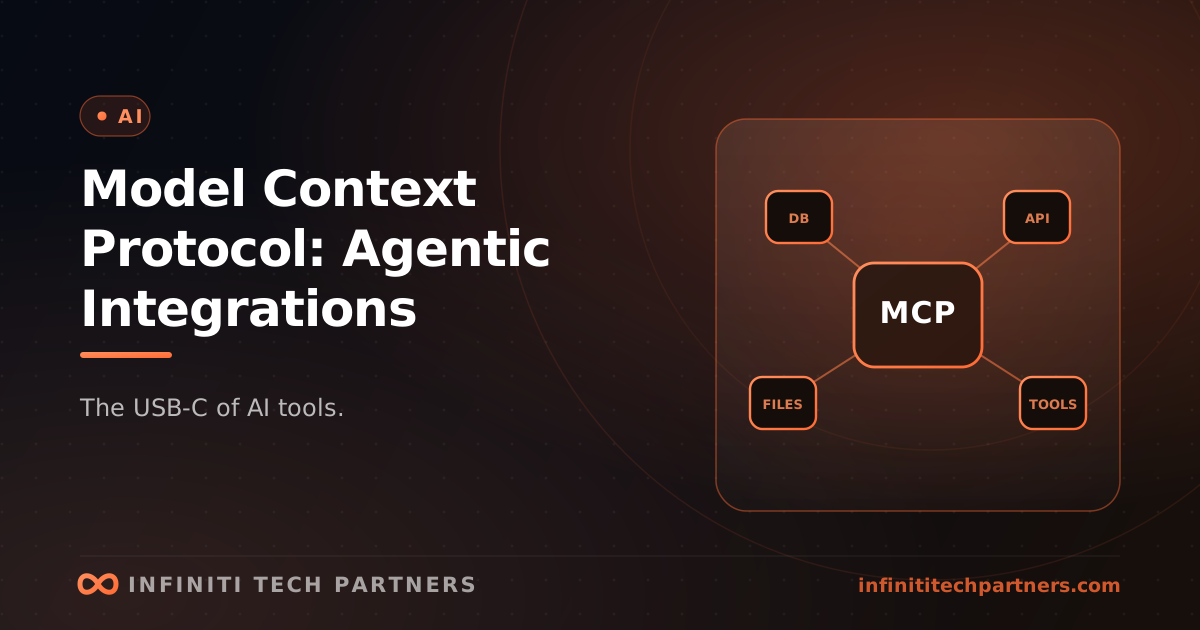
For two years, connecting an AI agent to your systems meant writing bespoke glue for every model and every tool: a custom function schema here, a hand-rolled adapter there, all of it rewritten when you switched providers. The Model Context Protocol (MCP) is the standard that ends that — an open protocol that defines how AI applications discover and call external tools, read resources, and pull in context, the same way regardless of which model is driving. The analogy people reach for is USB-C: instead of a different cable for every device, one standard interface. Build an MCP server for your database, your ticketing system, or your internal API once, and any MCP-aware agent can use it. That's the shift — from N×M custom integrations to a protocol both sides speak.
What MCP actually is
MCP is a client–server protocol. The host is the AI application (a chat client, an IDE assistant, your own agent); it runs one or more MCP clients, each connected to an MCP server. A server exposes three kinds of capability: tools (functions the model can call — 'create_ticket', 'query_orders'), resources (data the model can read — files, records, documents), and prompts (reusable templates). The model, via the host, discovers what a server offers and calls it through a uniform interface. Crucially, MCP standardizes the plumbing, not the intelligence: it's how the agent reaches your systems, while the reasoning about when and why to call a tool still lives in the model and your agent design. Get the protocol boundary right and you can swap models without rewriting a single integration.
Why it matters now
The value compounds because it's an ecosystem play. Once your capabilities are exposed over MCP, they work with every client that speaks the protocol — today's assistants and tomorrow's — with no per-vendor rewrite. Internally, it turns integration into a library: each team ships an MCP server for its domain, and any agent across the company composes them. It also cleanly separates the two jobs that used to be tangled: the platform team owns the servers (safe, audited access to systems), and the product team owns the agent (the reasoning). That boundary is exactly what was missing in the messy early integrations we described in lessons from shipping AI agents to production — a stable contract between the model and the world it acts on.
Designing a good MCP server
- Model tools around intent, not your API surface. 'schedule_delivery' beats exposing twelve raw CRUD endpoints — the model reasons better about a few well-named, task-shaped tools than about a sprawling REST map.
- Write descriptions for the model, not the developer. The tool's description and parameter docs are the model's only guide to when and how to call it; vague text produces wrong calls. Be explicit about what it does, what it returns, and when not to use it.
- Return results the model can use. Structured, concise output beats dumping raw payloads that blow the context window. Summarize, paginate, and shape responses toward the decision the agent is making.
- Make tools idempotent and safe to retry where you can. Agents retry; a 'create' that fires twice on a retry is a bug the model won't catch for you.
- Fail loudly and usefully. An error message the model can read ('order not found: check the ID format') lets the agent self-correct; an opaque 500 just derails it.
Security is the whole game
An MCP server is a bridge between a non-deterministic model and your real systems — which makes it a security surface, not just an integration. Two threats dominate. First, over-broad access: a server that hands an agent god-mode credentials means any successful prompt injection inherits that power. Give each server least-privilege, scoped credentials, and put consequential, irreversible actions behind a human approval gate. Second, the confused-deputy problem: the agent acts with the server's authority, so authorization must be enforced at the server on every call — never assume the model will respect a 'don't touch other tenants' data' instruction in a prompt. Add an audit log of every tool invocation, validate all inputs as if they came from an attacker (because via indirect injection, they effectively can), and treat a third-party MCP server you didn't write with the same suspicion as any untrusted dependency.
Where MCP fits — and where it doesn't
MCP is the right tool when an agent needs to take actions or reach live systems: query a database, file a ticket, call an internal service, read a document store. It is not a replacement for retrieval when your real need is grounding answers in a knowledge base — that's still a RAG problem, and MCP might be how the agent reaches the retriever rather than the retrieval itself. And it doesn't make a weak agent smart: if the model can't reason about which tool to use, a cleaner protocol won't save it. Think of MCP as fixing the integration layer — the part that used to be N×M bespoke adapters — so your effort goes into the agent's judgment and your servers' safety, not plumbing.
How Infiniti Tech Partners builds agentic systems
We build MCP servers that expose your systems to agents safely — intent-shaped tools, least-privilege scoped credentials, human-approval gates on the actions that matter, and full audit logging — so your AI features can actually do things without becoming a liability. And we design the agents on top of them, choosing where an autonomous loop earns its keep and where a tighter, more predictable pattern is the better call. If you're moving from AI that answers to AI that acts, that transition is where the real engineering is — let's talk.
Frequently asked questions
What is the Model Context Protocol (MCP)?
MCP is an open, client–server protocol that standardizes how AI applications connect to external tools, data, and context — the same way regardless of which model is driving. An MCP server exposes tools (functions the model can call), resources (data it can read), and prompts (reusable templates), and any MCP-aware agent can discover and use them through a uniform interface. It's often described as the USB-C of AI integrations: build a server for your database or internal API once, and it works with every client that speaks the protocol instead of needing bespoke glue per model.
How do you secure an MCP server?
Treat an MCP server as a security surface, not just an integration, because it bridges a non-deterministic model and your real systems. Give each server least-privilege, scoped credentials so a successful prompt injection can't inherit god-mode access, and put consequential or irreversible actions behind a human approval gate. Enforce authorization at the server on every call rather than trusting a prompt instruction, validate all inputs as if they came from an attacker, and keep an audit log of every tool invocation.
When should you use MCP versus RAG for an AI feature?
Use MCP when an agent needs to take actions or reach live systems — query a database, file a ticket, call an internal service. Use RAG when your real need is grounding answers in a knowledge base; MCP might be how the agent reaches the retriever, but it isn't a replacement for retrieval itself. MCP fixes the integration layer that used to be N×M bespoke adapters, but it doesn't make a weak agent smart — the reasoning about when and why to call a tool still lives in the model and your agent design.
Related reading
Guardrails for LLM Agents in Production: Shipping AI That Can Act
How to safely ship LLM agents that take real actions — scoping tools and permissions, validating inputs and outputs, bounding loops and cost, keeping humans in the loop for high-stakes steps, and the observability agents demand.
AIStructured Outputs and Tool Calling: Making an LLM Return Something You Can Use
The gap between a demo and a product is usually parsing. How to get reliable structured output from a model, and where tool calling really breaks.
AIModel Routing and Provider Failover: Not Betting the Product on One Model
Hardcoding one model is an availability, cost, and quality risk. How to build routing and failover without an abstraction that costs more than it saves.