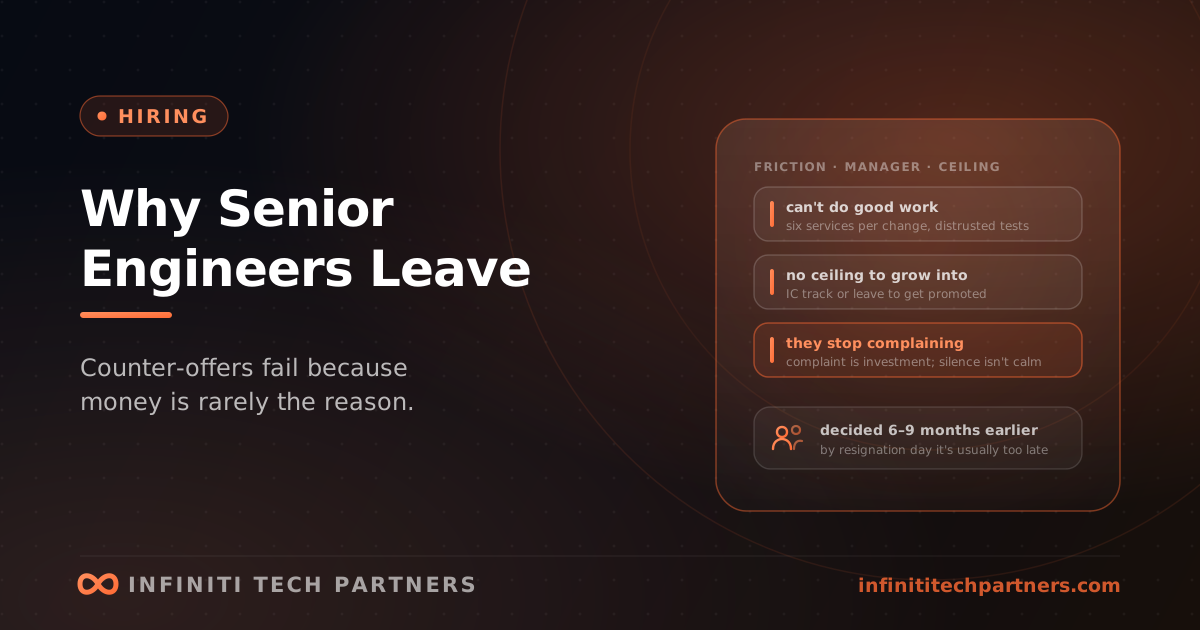
A senior engineer resigns, the counter-offer is prepared within a day, and roughly half the time it is accepted — and roughly half of those people leave anyway within a year. That pattern is the clearest available evidence that the resignation was not primarily about money, and that by the time it is delivered the decision has usually been forming for six to nine months. The expensive part is not the departure itself but everything attached to it: the search, the ramp, the knowledge that leaves with them, and the quiet reassessment their departure triggers in the two people who sat closest to them.
What it costs, so the effort is proportionate
The replacement cost of a senior engineer is commonly quoted at somewhere between six months and a year of their salary, and when you assemble it from the parts that estimate looks conservative. There is the search itself, which takes three to six months and carries agency fees of twenty to twenty-five percent of first-year salary where agencies are involved. There is ramp time, two to four months before the replacement is producing at full output. There is the productivity hole in between, during which the departing engineer's work is absorbed by colleagues who were already fully committed. There is the knowledge that does not transfer regardless of the handover — why the payments module is shaped that way, which customer has the unusual configuration, what happened the last time someone touched the scheduler. And there is the contagion effect, which is the largest and least measured term: departures cluster, because a senior engineer leaving is read by their colleagues as information about the company, and it prompts people who were not looking to start. On a team of fifteen, three senior departures in a year is not an attrition statistic, it is a delivery crisis.
The four reasons, in the order they actually appear
The first and most common is the slow erosion of the ability to do good work. Not one bad decision but the accumulation — a codebase where every change requires touching six services, a test suite nobody trusts, a deployment process that takes an afternoon, priorities that change often enough that nothing ever ships. Senior engineers are people who care about outcomes, and an environment where effort does not convert into outcomes is corrosive to exactly the people you most want to keep. The second is a manager problem, usually not an abusive one but an absent one: no feedback, no advocacy, no visible interest in their growth, decisions that affect them made without them. The third is the ceiling — a real or perceived limit on how far they can go without becoming a manager, which is the single most common reason strong individual contributors take an external offer, because a title change elsewhere is often the only available promotion. The fourth is a values mismatch that has been accumulating quietly, about how the company treats customers, how decisions get made, or what happens to quality under deadline pressure. Compensation appears on this list mainly as a trigger rather than a cause: it is what makes someone answer a recruiter, and the reasons above are what makes them take the call seriously.
The levers that actually work
- Fix the friction. Build times, flaky tests, deploy pain, environment setup, the thing everyone complains about in every retrospective and nobody is allocated to fix. This is the highest-return retention work available and it is almost always underfunded because it never competes well against a roadmap item.
- Build a real senior individual-contributor track with genuine scope and compensation parity to management, not a title with no authority attached. Without it, your best engineers must leave to advance.
- Give ownership of something that matters, with the authority to make decisions about it rather than the responsibility for its outcomes.
- Pay attention to who they work with. Senior engineers stay for peers they learn from more than for any other single factor, and one strong hire on a team improves retention across it.
- Review compensation proactively rather than reactively. A market adjustment offered before anyone asks costs the same money and carries an entirely different message from one offered after a resignation.
- Give the manager relationship real weight: regular one-to-ones that are not status meetings, honest feedback in both directions, and visible advocacy in rooms the engineer is not in.
- Protect time for the work that has no ticket — the refactor, the tooling, the investigation. Teams with zero slack ship less over a year, not more.
The signals that precede a resignation
The warning signs are consistent and almost always visible for months, which is what makes them useful. Engagement narrows: someone who used to comment on other people's designs, argue in architecture discussions, and raise problems in retrospectives becomes agreeable and quiet, and the quiet is frequently mistaken for contentment. Ownership contracts to exactly the assigned task. Investment in the future stops — no more interest in hiring, in mentoring, in the roadmap beyond this quarter. Calendar patterns shift. And most tellingly, they stop complaining, because complaint is a form of investment and its absence usually means the decision has been made. The right response to noticing this is a direct, low-stakes conversation rather than a project to fix them: asking what would have to change for the next year to be one they would want, and then being honest about which of those things you can actually change. Some of the time the answer is that you cannot, and a clean, well-managed departure with a proper handover is a much better outcome than six months of disengagement followed by a surprise. Skip-level conversations and honest exit interviews conducted by someone other than the departing person's manager are the two cheapest sources of this information, and most companies do neither seriously.
What to do when someone resigns anyway
Counter-offers deserve a clear policy decided in advance, because deciding in the moment produces bad outcomes in both directions. The case against them is strong: if the underlying reason was not compensation, money does not address it, and the acceptance often defers the departure by a year while telling the rest of the team that resigning is how you get a raise. The case for is narrow and real — someone genuinely underpaid relative to market, in a role you have no path to backfill quickly, where the reason is specifically compensation and the manager relationship is sound. Where a counter is not right, the useful posture is a good departure rather than a resentful one: a real handover, documentation of the things only they know, an honest exit conversation, and an alumni relationship, since senior engineers who leave well refer people, come back, and become customers surprisingly often. Then do the postmortem you would do for an incident. Ask what the actual cause was, when the decision was likely made, and what would have changed it — and if the same theme appears in the third exit interview in a row, you have a systemic issue that no amount of individual retention effort will touch.
How Infiniti Tech Partners fits in
We are not an HR consultancy and we do not run retention programmes, but we sit next to this problem constantly because the situations that bring clients to us are frequently the same ones driving their engineers out — a delivery backlog nobody has capacity to clear, a legacy system every change fights against, or a team spending most of its week on toil. Where we help is by absorbing the work that is burning out your permanent engineers so they can spend their time on the parts of the system they actually want to own, and by fixing the friction directly when that is the real problem: the build, the pipeline, the tests, the deploy path. Teams often use us as a bridge while they hire, which relieves the pressure on the people already there rather than adding to it. We keep a deliberately small number of concurrent engagements and plan the calendar about a quarter out. If you have just lost a senior engineer and can see the pressure landing on the two people who remain, that is a situation worth talking about before it becomes the second and third departure.
Frequently asked questions
Why do senior engineers leave, if not for money?
Four reasons, in rough order of frequency. The slow erosion of the ability to do good work — a codebase where every change touches six services, a distrusted test suite, an afternoon-long deploy, priorities that change often enough that nothing ships. A manager problem, usually absence rather than abuse: no feedback, no advocacy, no visible interest in growth. A ceiling, real or perceived, on how far they can go without becoming a manager, which is the most common reason strong individual contributors take an external offer. And an accumulating values mismatch. Compensation is usually the trigger that makes someone answer a recruiter, not the cause.
What actually improves engineer retention?
Fix the friction — build times, flaky tests, deploy pain, the thing raised in every retrospective that nobody is allocated to fix. It is the highest-return retention work available and it is chronically underfunded because it never competes well against a roadmap item. Then build a real senior individual-contributor track with scope and compensation parity to management, give ownership with actual decision authority, invest in the peers they learn from, review compensation proactively rather than after a resignation, give the manager relationship real weight, and protect time for work that has no ticket.
Should you make a counter-offer when an engineer resigns?
Decide the policy in advance rather than in the moment. The case against is strong: if the reason was not compensation, money does not address it, and acceptance often defers the departure by a year while signalling to the team that resigning is how you get a raise — roughly half of accepted counter-offers still end in departure within a year. The narrow case for is someone genuinely underpaid relative to market, in a role you cannot backfill quickly, where the reason is specifically compensation and the manager relationship is sound. Otherwise aim for a good departure: real handover, honest exit conversation, and an alumni relationship.
Related reading
Onboarding Engineers: What the First 90 Days Should Actually Produce
Ramp time is the most expensive unmeasured number in engineering. What good onboarding produces week by week, and the documentation that actually matters.
HiringHiring Senior Engineers: An Interview Loop That Predicts Performance
Most senior loops measure recall and interviewing stamina. What to assess instead, how long the process should take, and where good candidates leave.
HiringHow to Choose an Engineering Partner: Red Flags, Green Flags, and the Questions That Matter
A buyer's guide to evaluating engineering partners — the signals that predict a good engagement, the red flags worth walking away from, and how to structure the first 90 days so you find out early.