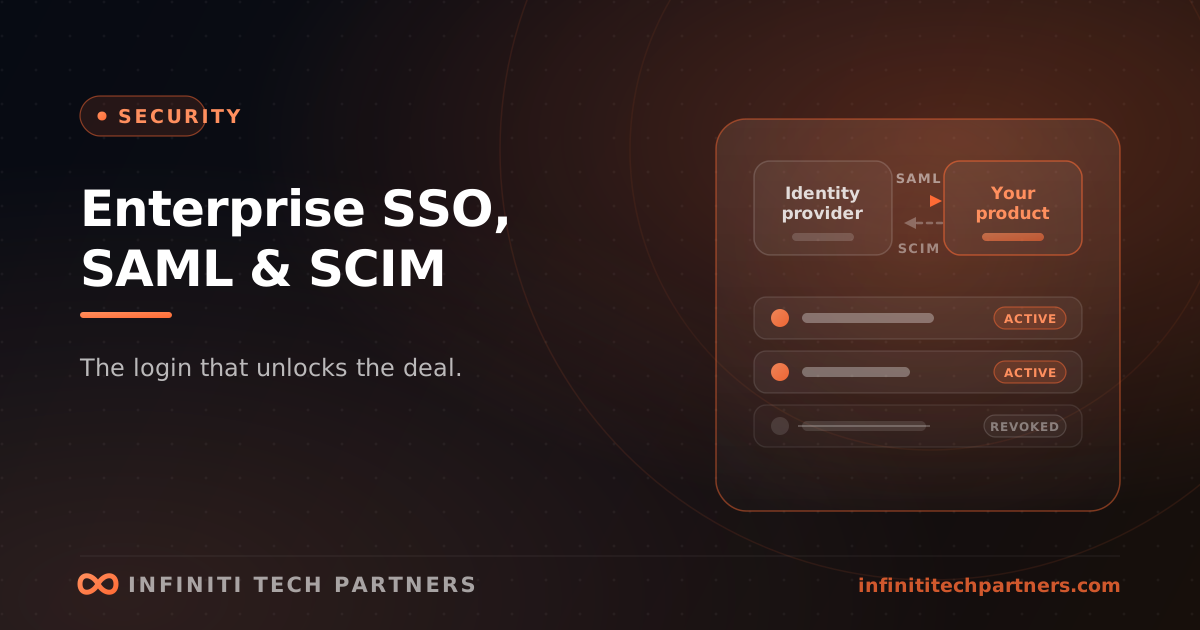
Somewhere between your first mid-market logo and your first genuine enterprise deal, authentication stops being a feature and starts being a gate. The buyer's IT team sends a one-line requirement — 'must support SSO via our identity provider, with SCIM provisioning' — and the deal quietly pauses until you can answer it. What makes this expensive is not the protocol work, which is a few weeks of well-trodden engineering. It's that supporting enterprise identity forces decisions about your user and organization data model that you almost certainly made differently in year one, and reversing them means touching every part of the product that assumes a user is an email address with a password.
What enterprise buyers actually ask for
- SAML 2.0 or OIDC single sign-on against their identity provider — in practice Entra ID, Okta, Google Workspace, or Ping, and you will be asked to support all of them.
- SCIM 2.0 provisioning and, more importantly, deprovisioning — so that removing someone in the IdP removes their access to your product without a support ticket.
- Enforced SSO at the organization level: once it's on, password login must stop working for that domain, including for users who already had accounts.
- Role and group mapping — IdP groups translating into your product's roles, so access is managed in one place rather than two.
- Audit logs the customer can export or stream, covering logins, permission changes, and administrative actions, with enough retention to satisfy their own compliance program.
- Session and MFA policy: configurable session lifetime, forced re-authentication for sensitive actions, and honouring the IdP's MFA rather than layering your own on top.
SAML and OIDC, briefly and practically
OIDC is the modern option and much pleasanter to implement — JSON, well-supported libraries, a clean token model. SAML is XML, older, more fiddly, and still what a large share of enterprise IT departments will hand you, which is why 'we support OIDC only' is not a viable position for an enterprise product. The operational details matter more than the protocol choice. You need to handle both IdP-initiated and SP-initiated flows because customers will use both. You need a self-service setup flow where a customer admin uploads metadata or pastes a URL, because coordinating a manual configuration call for every connection does not scale past a handful of customers. And you need certificate expiry handling — signing certificates rotate, usually annually, and the failure mode is a customer's entire workforce being locked out on a Monday morning with no warning. Track expiry dates, alert your team and theirs weeks ahead, and support multiple valid certificates during rotation.
SCIM is the part teams underestimate
SSO is about authentication — proving who someone is at login. SCIM is about lifecycle — making sure the right accounts exist and, crucially, that the wrong ones don't. Security teams care about the second half far more than the first, because an employee who leaves and retains access to a SaaS tool is exactly the exposure their access reviews are designed to catch. Implementing SCIM means exposing a standard-shaped API that the customer's IdP calls to create, update, deactivate, and group users, and it has to be tolerant: identity providers send partial updates, replay operations, and occasionally deactivate and reactivate the same user in quick succession. Treat those calls as idempotent, make deactivation a reversible state rather than a destructive delete, and decide deliberately what happens to a deactivated user's data, comments, assignments, and API tokens — that last one is the gap that lets a departed employee's automation keep running after their login is gone. Just-in-time provisioning on first SSO login is a reasonable interim step, but it only creates users; it never removes them, which is the half that gets audited.
The data model decisions that hurt later
Most retrofit pain traces to a handful of early assumptions. Email as the primary identity breaks when a customer changes domains after an acquisition, so key users on a stable internal identifier and treat email as a mutable attribute. A user belonging to exactly one organization breaks the moment a consultant, agency, or partner needs access to two of your customers, so model membership as its own relationship rather than a column on the user. Authentication method as a global user setting breaks when one organization enforces SSO and another doesn't — the policy belongs to the organization, not the person. You also need domain claiming, with proof of ownership, or one customer can enforce SSO over email addresses belonging to another. And you need a documented break-glass path: a way in when the customer's IdP is down or misconfigured, tightly restricted and heavily logged, because the alternative is your support team improvising access grants under pressure. Finally, expect to charge for this. The old argument about whether SSO should be a paid tier has largely settled in a sensible place — it is legitimately more expensive to build and support, it belongs in an enterprise plan alongside audit logs and role management, and pricing it as a bundle of enterprise controls reads better to a buyer than pricing security as an upsell.
Build, buy, or wrap
Writing your own SAML implementation is not a good use of your engineering time; the specification is large, the security-sensitive parts are subtle, and the bugs are the kind that appear in vulnerability disclosures. The realistic choices are an identity platform that handles the protocol layer for you, or a well-maintained library wired into your own user model. Platforms buy speed and take the per-connection support burden — customer-facing setup flows, IdP quirks, certificate rotation — off your team, at a cost that typically scales per connection or per monthly active user and can become a real line item as you add enterprise logos. Libraries keep the cost flat and the user model entirely yours, but you own the operational edges. The pattern that works well for growth-stage teams is to keep your own user, organization, and membership model as the source of truth, and use a platform strictly for the federation layer — so that changing providers later is an integration change, not a migration of your entire identity graph. Whichever you pick, put SSO configuration behind the same zero trust thinking as the rest of your admin surface: it is the highest-value setting in your product, and changing it should require re-authentication and land in the audit log.
How Infiniti Tech Partners handles enterprise identity
We treat enterprise auth as a revenue-unblocking project with a security review attached, because that's what it is. A typical engagement starts by mapping your existing user and organization model against what SSO, SCIM, and per-organization policy will require, so the reversible decisions get made before the protocol work starts rather than after. We then implement SAML and OIDC with self-service configuration your customers' admins can complete without a call, SCIM provisioning with deprovisioning that actually revokes tokens and sessions, IdP group-to-role mapping, and exportable audit logs — plus certificate expiry monitoring and a documented break-glass path, which are the two things that turn into incidents later. We test against real identity providers rather than a single reference implementation, because Entra ID, Okta, and Google Workspace each have their own behaviours. If you have an enterprise deal waiting on an identity requirement and a date attached to it, that's a scope we can size quickly — talk to us before you commit to the timeline in the contract.
Frequently asked questions
What does enterprise-ready authentication actually require?
Enterprise buyers typically ask for SAML 2.0 or OIDC single sign-on against their identity provider (in practice Entra ID, Okta, Google Workspace, or Ping — you'll be asked to support all of them), SCIM 2.0 provisioning and deprovisioning, SSO enforced at the organization level so password login stops working for that domain, IdP group-to-role mapping, exportable audit logs covering logins and permission changes, and configurable session and MFA policy. Supporting OIDC only isn't a viable position, because a large share of enterprise IT departments will hand you SAML.
What is SCIM and why does it matter more than SSO to security teams?
SSO handles authentication — proving who someone is at login. SCIM handles lifecycle: making sure the right accounts exist and, crucially, that the wrong ones don't. Security teams care more about deprovisioning because an employee who leaves and keeps access to a SaaS tool is exactly what their access reviews are designed to catch. A SCIM implementation must be idempotent (identity providers send partial updates and replay operations), treat deactivation as a reversible state rather than a destructive delete, and revoke API tokens and sessions — the gap that lets a departed employee's automation keep running after their login is gone.
Should we build SAML support ourselves or use an identity platform?
Writing your own SAML implementation is a poor use of engineering time — the specification is large, the security-sensitive parts are subtle, and the bugs end up in vulnerability disclosures. Use either an identity platform that handles federation for you (faster, and it absorbs the per-connection support burden, but typically priced per connection or per monthly active user) or a well-maintained library wired into your own user model (flat cost, but you own the operational edges). The pattern that ages well is keeping your own user, organization, and membership model as the source of truth and using a platform strictly for the federation layer, so changing providers later is an integration change rather than an identity migration.
Related reading
Security Questionnaires: How to Stop Losing Two Weeks Per Deal
Enterprise security reviews stall deals and consume engineering time. How to build an answer library, a trust center, and get ahead of the questions.
SecurityProduction Access: Who Can Touch the Database at 2am
Standing production access is what auditors and enterprise buyers probe hardest. How to move to just-in-time access without slowing incident response.
SecurityAudit Logging for Enterprise SaaS: What Buyers Actually Require
Application logs are not audit logs. What enterprise security reviews ask for, why immutability matters, and how to build it before a deal depends on it.