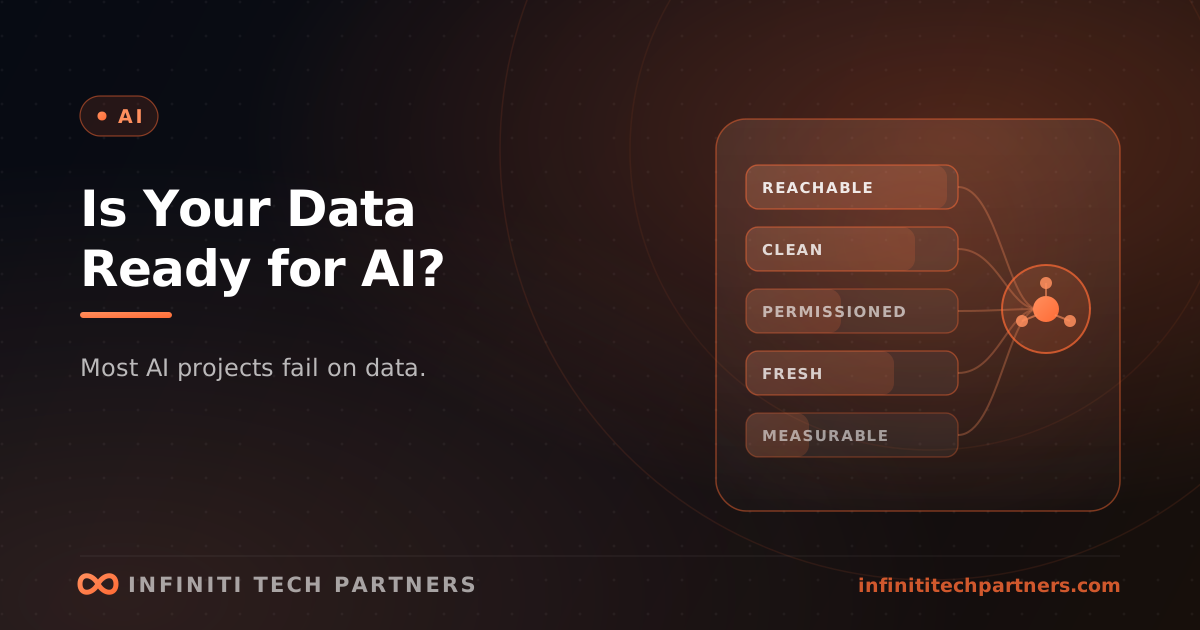
The uncomfortable pattern in enterprise AI is that the model is almost never the hard part. Teams spend months evaluating providers and architectures, ship an impressive demo built on a curated sample, and then discover that the real data is scattered across six systems, half of it is stale, the permissions model doesn't survive contact with a multi-tenant product, and nobody can define what a correct answer looks like. The project doesn't fail loudly — it stalls in pilot, gets quietly descoped, and becomes the reason the next AI proposal gets a colder reception. Almost all of that is preventable with an honest readiness assessment before anyone writes an integration. This is what that assessment should cover, and what to do when the answers come back uncomfortable.
1. Can you actually reach the data?
Start with the least glamorous question: for the use case you have in mind, where does the data live, and can a system get at it programmatically today? A surprising proportion of enterprise knowledge sits in places that are hard to reach in practice — PDFs in a shared drive, a wiki nobody has maintained since a reorg, tickets in a support tool with a rate-limited API, tribal knowledge that exists only in Slack threads and people's heads. 'We have all this data' and 'a system can retrieve the right slice of it in 200 milliseconds' are very different statements. Inventory the actual sources, check whether each has a usable API or export path, and note what format the content is really in — because scanned documents, screenshots pasted into tickets, and spreadsheets used as databases all need work before they're useful to a retrieval pipeline. This inventory usually is the project plan; it just doesn't look like one until you've done it.
2. Is it good enough to answer from?
Language models are extremely good at producing a confident answer from bad source material, which makes data quality a safety problem rather than an aesthetic one. The failure isn't a system that says 'I don't know' — it's a system that authoritatively cites a policy document superseded two years ago. Audit for the things that actually poison retrieval: duplicates and near-duplicates that crowd out the right answer, contradictory versions of the same document with no way to tell which wins, missing or wrong metadata so nothing can be filtered by recency or ownership, and content that was never true. You don't need to fix everything — you need to know the state of the corpus for your specific use case, and to decide deliberately what's in scope. Narrowing the corpus to the material you can vouch for is almost always a better opening move than ingesting everything and hoping retrieval sorts it out.
3. Whose data is it, and who's allowed to see the answer?
This is the readiness question teams skip and then rediscover expensively. In most enterprises, access to information is not uniform — HR documents, customer records, and financial data all have rules, and in a multi-tenant product the rules are absolute. An AI feature that retrieves across everything and answers freely is a permissions bypass with a friendly interface, and it will eventually surface something to someone who shouldn't see it. The requirement is that retrieval is filtered by the identity of the person asking, enforced server-side, before anything reaches the model — the same object-level authorization discipline you'd apply to any API, extended to your index. Ask early whether your source systems even expose the permission metadata needed to do that, because if they don't, building it is part of the project rather than a detail. This is also where the privacy questions enterprise buyers will ask you live: what leaves your infrastructure, what's retained, and what a security reviewer will be told.
4. How fresh does it need to be — and who keeps it that way?
Every retrieval system is a copy of your data, which means it starts going stale the moment it's built. The right freshness requirement varies enormously by use case: a policy assistant can tolerate a nightly refresh, an assistant answering questions about live order status cannot tolerate any lag at all, and the architecture is completely different in each case. Decide this before you design, because retrofitting real-time updates onto a batch-indexed system is a rebuild. The related question is ownership — who is responsible for the corpus a year from now, who notices when a source system changes its schema, and who removes content that's been superseded. Unowned AI features degrade quietly: the answers get subtly worse, users stop trusting them, usage decays, and the post-mortem concludes that 'AI didn't work for us' when what actually happened is that nobody was maintaining the data behind it.
5. Is the use case narrow enough to be measurable?
The most common strategic error is picking something too broad to evaluate. 'An assistant that answers any question about our business' cannot be tested, so it can never be shown to be good enough to ship, and it drifts indefinitely in pilot. Pick something narrow, high-frequency, and consequential enough to matter: drafting first-pass responses to a specific category of support ticket, summarizing a specific document type, answering questions from one well-maintained corpus. Then define what correct looks like and build an evaluation set — a few hundred real inputs with known good outputs — before you build the feature. That eval set is what converts 'it seems better' into a number, what lets you change models or prompts without fear, and what tells you when you're actually done. Teams that build the eval first ship; teams that build the demo first iterate on vibes until the enthusiasm runs out.
What to do if the answers are uncomfortable
Finding out that your data isn't ready is a good outcome, not a blocked project — it's just a different first phase than the one you planned. The sequence that works is to narrow the scope until the data problem is tractable: one corpus you can vouch for, one workflow, one measurable outcome. Fix the permission model before the feature, not after, because retrofitting authorization into a retrieval layer is far more expensive than designing it in. Do the unglamorous data work — deduplicate, add metadata, establish an update path — with the specific use case as the scope boundary, so you're not attempting a company-wide data cleanup as a prerequisite to shipping anything. And ship the narrow thing, measure it, and let the second use case inherit the plumbing. The organizations getting real value from AI aren't the ones with the best models; they're the ones that did this work first and then found the second and third use case were 80% cheaper because the foundations already existed.
How Infiniti Tech Partners runs AI readiness
We do this assessment as a short, self-contained engagement, precisely because it's the step most teams skip and the one that determines whether the rest of the money is well spent. We inventory where the data actually lives and whether it's reachable, audit the corpus for the quality problems that poison retrieval, map the permission model onto what your source systems can actually enforce, pin down freshness requirements before they become architectural surprises, and help you pick a first use case narrow enough to measure — then build the evaluation set that proves it works. You end up with a plan grounded in your real data rather than a demo built on a curated sample, and often with a clear-eyed 'not yet, do this first.' We take on a limited number of engagements at once so the senior team stays hands-on, and AI work has been the fastest-filling part of our calendar — if an AI feature is on your roadmap for this year, an early conversation costs nothing and will sharpen the scope either way.
Frequently asked questions
How do I know if my company's data is ready for AI?
Audit five things before you build: whether a system can actually reach the data programmatically today (not just whether you 'have' it), whether the corpus is good enough to answer from (duplicates, contradictory versions, missing metadata, and content that was never true all poison retrieval), whether your source systems expose the permission metadata needed to filter retrieval by who's asking, how fresh the data must be and who owns keeping it that way, and whether your use case is narrow enough to measure. Most AI projects stall on these, not on the model.
Why do enterprise AI pilots fail to reach production?
Usually because the demo was built on a curated sample and the real data is scattered across six systems, half stale, with a permissions model that doesn't survive a multi-tenant product — and because nobody defined what a correct answer looks like, so the project can never be shown to be good enough to ship. Picking something too broad ('an assistant that answers any question about our business') guarantees this, since it can't be tested and drifts indefinitely in pilot.
What should the first AI use case look like?
Narrow, high-frequency, and consequential enough to matter — drafting first-pass responses to one category of support ticket, summarizing one document type, or answering questions from a single well-maintained corpus. Define what correct looks like and build an evaluation set of a few hundred real inputs with known good outputs before you build the feature. That eval set converts 'it seems better' into a number, lets you swap models or prompts without fear, and tells you when you're done. Teams that build the eval first ship; teams that build the demo first iterate on vibes.
Related reading
Structured Outputs and Tool Calling: Making an LLM Return Something You Can Use
The gap between a demo and a product is usually parsing. How to get reliable structured output from a model, and where tool calling really breaks.
AIModel Routing and Provider Failover: Not Betting the Product on One Model
Hardcoding one model is an availability, cost, and quality risk. How to build routing and failover without an abstraction that costs more than it saves.
AIAI Coding Assistants in the SDLC: Where They Pay Off and Where They Cost You
A grounded look at AI-assisted development for engineering leaders — the work where it genuinely compounds, the second-order costs in review and security, and the guardrails worth setting.